Denver missed 24 tackles. Here is what that is actually worth.
The worst Week 1 tackling performance on record, the number the coverage got wrong, and the reason it tells you almost nothing about the Broncos in October.
Pro Football Reference published its advanced defensive charting for the full Week 1 slate on Thursday morning. We had been waiting on one game.
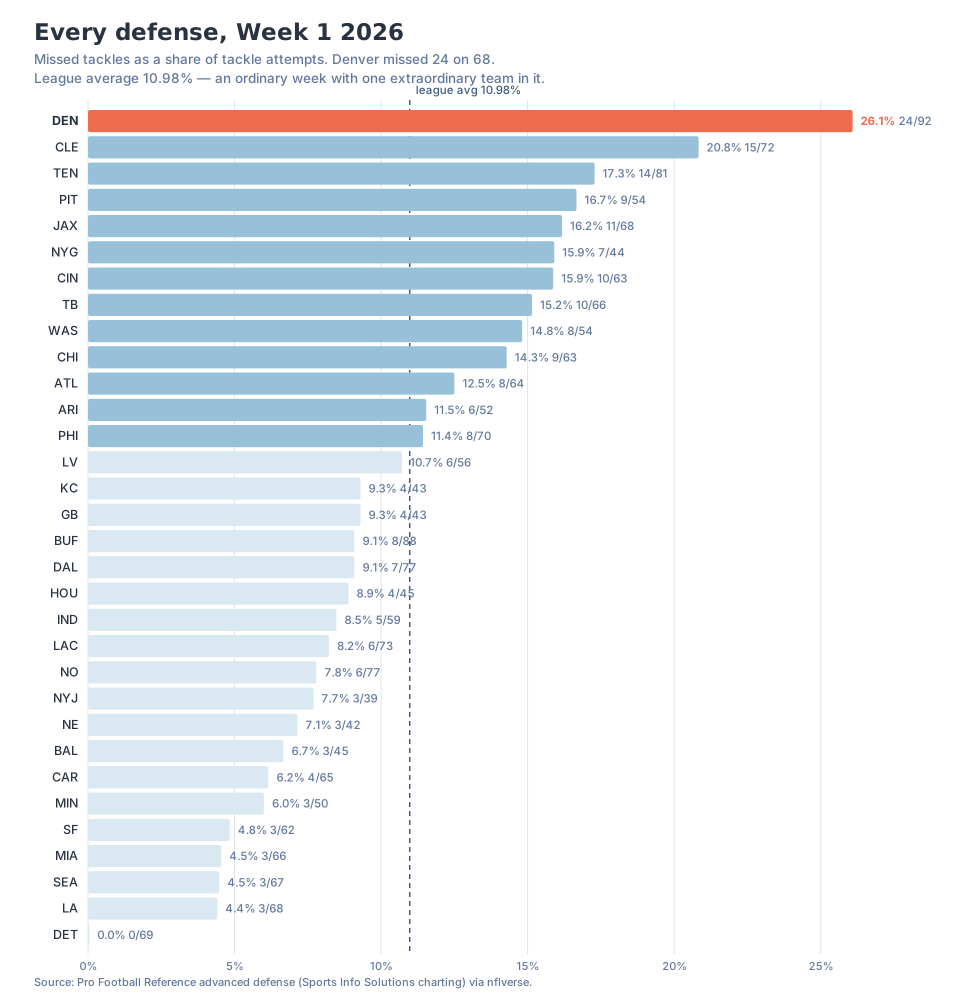
Denver missed 24 tackles on 68 combined attempts against Kansas City, a 26.1 percent rate. That is the worst mark in the league by more than five points, and the worst Week 1 team-game in the ten seasons this data has existed.
 Tap to open full size, or swipe to pan.
The league as a whole missed 10.98 percent of its tackle attempts, against a 2018–2025 Week 1 average of 10.53 percent. So this was an ordinary opening weekend with one extraordinary team sitting on top of it. Detroit, at the other end, missed zero tackles on 69 attempts.
First, the number that has been going around is wrong
The figure in circulation after the game was 29.8 percent, described as the worst single-game rate since 2018. Neither half of that survives contact with the charting.
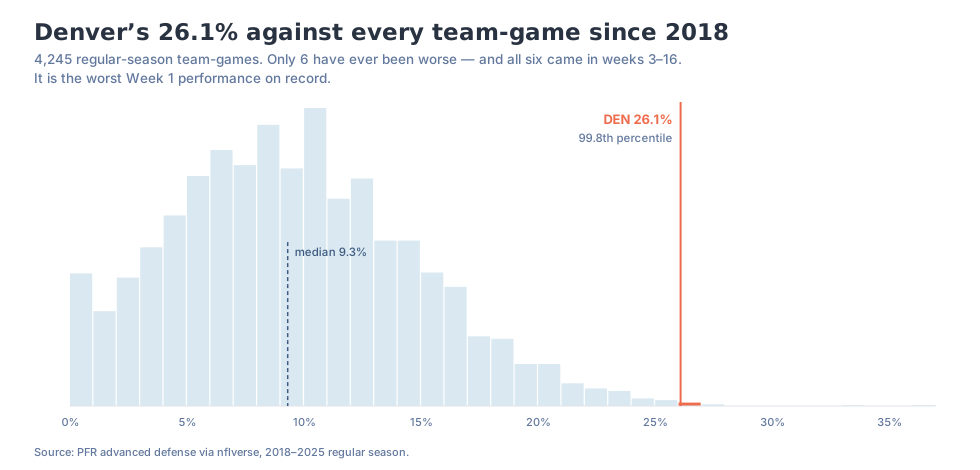
The rate is 26.1 percent, not 29.8. And "worst since 2018" is only true if you mean worst Week 1. Six team-games since 2018 have been worse (the record is Tennessee at 36.5 percent in Week 3 of last season), and every one of them came between weeks 3 and 16.
We suspect the 29.8 came from a different charting provider with a different denominator. The same thing happened with the widely quoted "Pittsburgh missed 13 tackles against Atlanta" line: Pro Football Reference has it at 9. Two providers, two numbers, neither reconcilable with the other. If you are going to cite a missed-tackle figure, cite whose it is.
It was the whole defense, not one guy
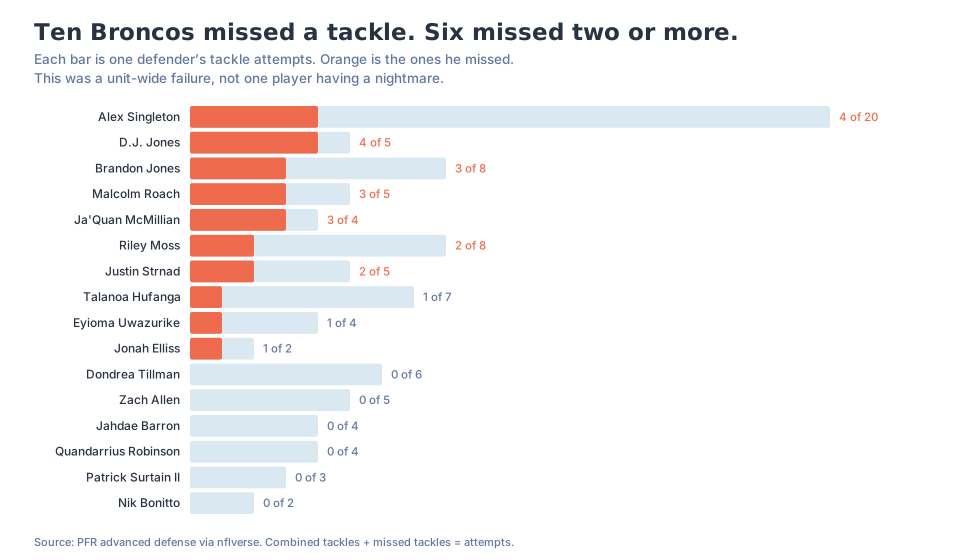
The easy story is a single player having a nightmare. That is not what happened.
 Tap to open full size, or swipe to pan.
Ten different Broncos missed at least one tackle. Six missed two or more. D.J. Jones went one-for-five on tackle attempts. Ja'Quan McMillian went one-for-four. Alex Singleton, who led the team with 16 combined tackles, still missed four.
Kansas City, on the same field the same night, missed 4 on 39, a 9.3 percent rate, almost exactly league average.
How historic is historic
 Tap to open full size, or swipe to pan.
Against the full distribution of 4,245 regular-season team-games from 2018 through 2025, Denver's 26.1 percent sits at the 99.8th percentile. The median team-game is 9.3 percent. This was a real outlier, not a media exaggeration. The exaggeration was only in the decimal places.
Now the part nobody tweets
Here is the same data with the context that changes what you should do about it.
 Tap to open full size, or swipe to pan.
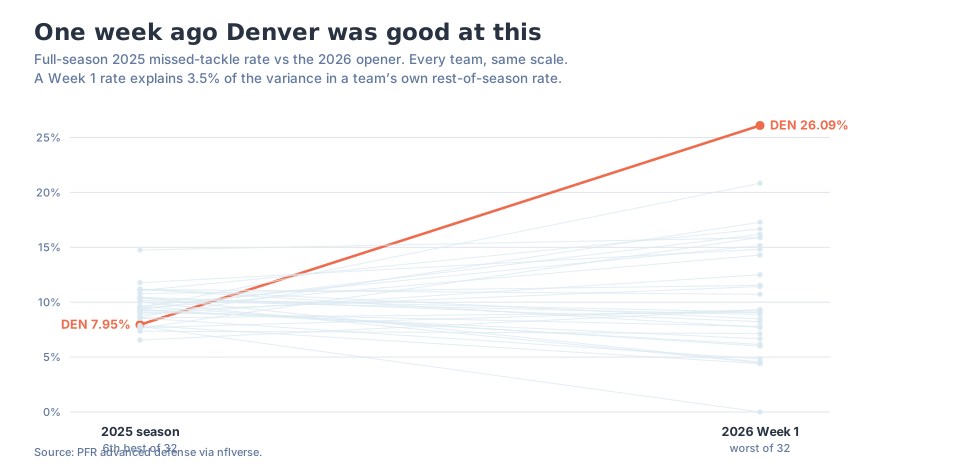
Denver finished the 2025 season at 7.95 percent, sixth-best in the league. They were, by this measure, one of the better tackling teams in football eleven days ago.
We went looking for how much a Week 1 tackling performance actually tells you about the rest of a season. The answer is: almost nothing.
- A team's Week 1 missed-tackle rate correlates with its own weeks 2–18 rate at r = 0.19. That is an R-squared of 0.035, three and a half percent of the variance.
- Split the rest of the season in half and correlate a team with itself across those halves, and you only get r = 0.41. That is the reliability ceiling on a half-season sample. Nothing built on one game can beat it.
- Season over season, team tackling rate carries at r = 0.42 once you strip out a charting artifact we will get to below. Being a bad tackling team is a real, somewhat sticky property. Having one bad tackling game is not evidence you are one.
Per-season, the Week 1 to rest-of-season correlation reads: 0.06, −0.06, 0.24, −0.12, −0.12, 0.39, −0.05, 0.07. Four of eight are negative. That is noise with a sign.
While we were in here: Week 1 is not the sloppy week
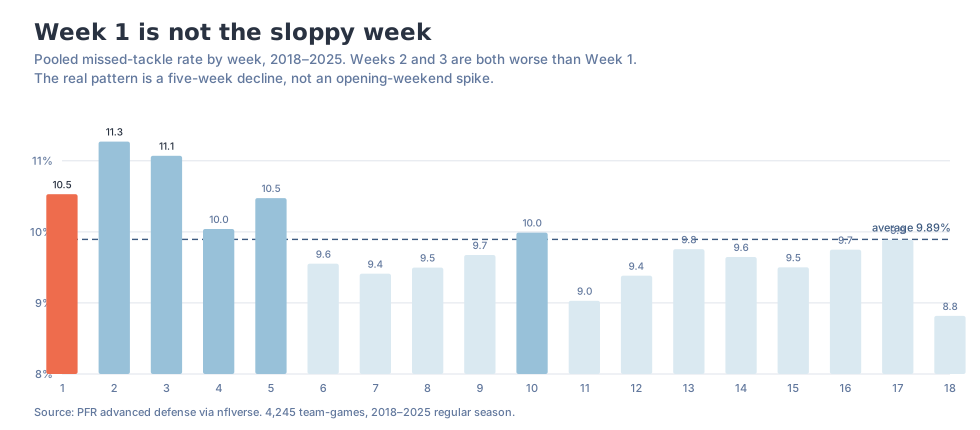
The reason we pulled this data at all was a claim that kept showing up in the coverage: that Week 1 is typically sloppy and gets cleaned up later. It is a reasonable-sounding story. It is not what the data says.
 Tap to open full size, or swipe to pan.
Week 1 pools to 10.53 percent against 9.85 percent for weeks 2 through 18. Real gap, wrong conclusion: Week 1 is only the third-highest week of eighteen. Weeks 2 and 3 are both worse. Once you account for the fact that team-games within a season are not independent draws (there are really only eight seasons and 32 recurring defenses, not 258,000 independent tackle attempts), the Week 1 effect lands at p = 0.23. Not significant.
What does replicate is wider and slower. Weeks 1–5 run 10.69 percent against 9.51 percent for weeks 11–18, and that holds in eight of eight seasons (p = 0.001). Tackling tightens up around Week 6, not after the opener.
We also went looking for the mechanism and found it is specifically a passing-game effect. Completion percentage and penalties both run high early and decline across the calendar. Yards per carry, explosive run rate, yards before contact, yards after contact, sack rate, and turnovers are all flat. Nobody schemes differently in September. They execute worse, in coverage and in the open field.
Two things we do not trust yet
The 2022 season is a charting artifact. Combined tackles and defenders charted are flat across 2021, 2022 and 2023, while missed tackles fall 34 percent for exactly one year and then come back. Defenses did not get a third better at tackling for twelve months and then forget. We confirmed it in a second, independent table: offensive broken tackles forced per carry show the identical one-year notch. Never compare a 2022 level to a neighboring season's.
Eight of the 32 team-games this week land on exactly three missed tackles, against roughly two expected. The league aggregate and the charted-defender counts both look healthy, so we read this as a rounding or early-publication quirk rather than bad data, but we would not cite an individual low-end team-game from Week 1 until Pro Football Reference finalizes.
What we would actually say about Denver
They had a historically bad night, in a way the charting fully supports and the circulated number overstated. Six defenders missed multiple tackles, which is a unit problem rather than a personnel problem, and unit problems are the kind that coaching addresses.
And the base rate is loud: a team that was sixth-best at this a season ago, judged on fourteen days and one opponent, is going to regress toward what it was. If you are pricing Denver's defense off Week 1, you are pricing 3.5 percent of the information and paying full freight for it.
Method and full working: missed-tackle rates are missed divided by (combined + missed), pooling numerators and denominators across a team's defenders rather than averaging player rates. Data is Pro Football Reference's advanced defensive charting, sourced from Sports Info Solutions, via nflverse. Significance tests treat the season as the unit of analysis, not the play.
Denver's rating and schedule are on the Broncos team file.
Data in this article
More from The Margin
All analysis- Team EPA per play is free on The Margin now. Here's what it says about who wins Super Bowls.
Jesse McConnell, Oct 6, 2026. NFL, 5 min read
Offense and defense EPA per play for all 32 teams, free, on the team ratings page and every team file. Since 2015, 8 of 11 champions were above average on both sides of the ball, and none was below average on both.
- How our NFL model works
Jesse McConnell, Oct 6, 2026. NFL, 3 min read
What goes into our NFL game projections, how a team rating becomes a projected margin and win probability, and why the market's line sits beside our number instead of inside it.
- How our college football model works
Jesse McConnell, Oct 6, 2026. CFB, 2 min read
What goes into our college football game projections, how a preseason rating and this season's results become one team rating, and why the market's line sits beside our number instead of inside it.